Lighting, sockets and faults
Lighting, sockets and fault finding
The everyday work: spotlights in the kitchen, an extra socket where you actually need one, a hob that has stopped, or a breaker that keeps tripping and nobody can say why.
NAPIT registered · 5.0 from 13 Google reviews · Pontyclun
Lighting
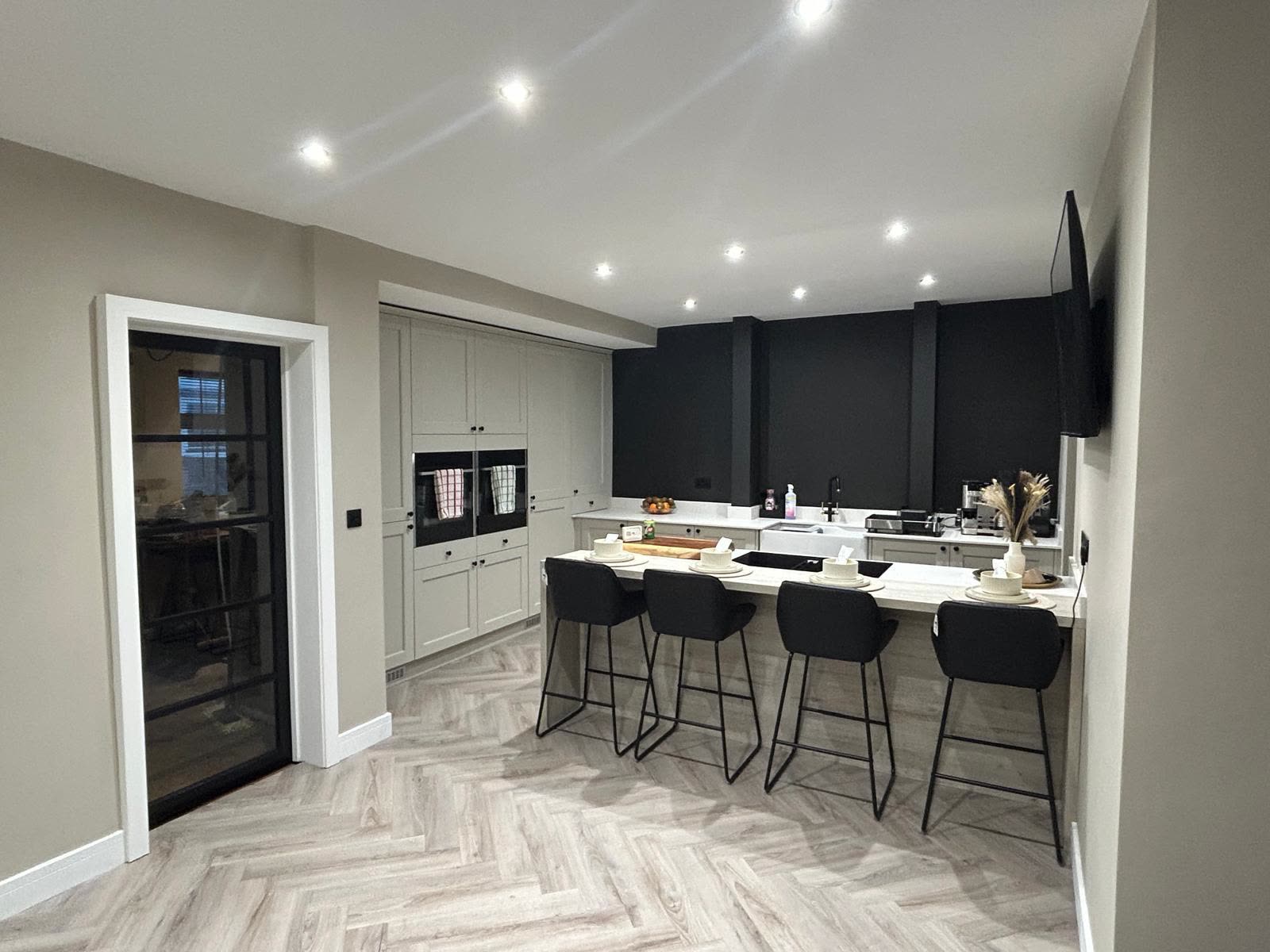
Downlights set out so the room is lit evenly rather than dotted about, pendants and wall lights, under-cupboard lighting in kitchens, and switching that matches how you use the room: two-way on the stairs, dimmers where they help, separate switching for zones in a big room.
Fittings can be supplied or you can buy your own, which plenty of people prefer when they have chosen something specific. Say which when you get in touch, because it changes the price.
Sockets and small additions
Extra sockets, doubles in place of singles, USB sockets, a socket in the loft for an aerial amplifier, a spur for a dishwasher or a new hob. Where the existing circuit can take it, these are quick jobs. Where it cannot, you get told that rather than having it added anyway and hoping.
Outside is a different job with its own rules, and it is covered on the garden power page.
Fault finding
The annoying ones: a breaker that trips at random, lights that flicker, a circuit that works until the kettle goes on, a shower that cuts out halfway through. Faults are found by testing, not by guessing, which sometimes means an hour with the meter before anything gets replaced. It is quicker in the long run than swapping parts until it stops.
Common culprits around here: water getting into an outside light or a loft-mounted junction box, a nail through a cable from a previous floor job, an overloaded ring in an older kitchen, and failing RCDs in boards from the 1990s.
Hobs, ovens and appliance circuits
Hob swaps are regular work: the new one is often a different load from the old, and the existing cable and protection do not always suit it. The honest check takes five minutes and saves replacing a cooker cable after the kitchen is back together.
How small jobs get priced
By the job, not by the hour. A photo on WhatsApp is usually enough for a straight figure: the fitting, the wall or ceiling it is going on, and your fuse board. If a couple of jobs can be done in one visit, they are cheaper together than spread across three.
Bigger pieces of work have their own pages: rewires, fuse boards, EV chargers and EICRs. For what an electrician should cost generally, see the pricing guide.
Questions people ask
Can you tell me the price from a photo?
For most small jobs, yes. Send the spot it is going, and a picture of your fuse board with the cover on.
My breaker trips when I plug something in. Is it the appliance?
Often, yes. Unplug everything on that circuit and reset it: if it holds, plug things back one at a time. If it trips with nothing plugged in, it is the wiring and it needs testing.
Are downlights a fire risk?
Fitted badly they can be, especially older halogens buried in insulation. Modern fire-rated LED fittings, installed with the right clearance, are not.
Do small jobs get a certificate?
Anything notifiable does, and you get the paperwork for it. A like-for-like swap does not need one, and nobody will pretend otherwise to add to the bill. If a job turns out to need a board change first, you hear that before it starts, not halfway through.
Where we work
Based in Pontyclun, covering Rhondda Cynon Taf, Cardiff, Barry and Penarth.
Tell Ryan what needs doing.
A message with a couple of photos is usually enough to get a straight figure back. No call centre, no obligation.
Prefer not to use WhatsApp? Text 07375 065820 . Whichever you use, it comes straight to Ryan.